Second Boer War
A colonial war over gold and British dominance in Southern Africa.

Unknown author · Public domain
Triggered by the Witwatersrand Gold Rush and disputes over voting rights for foreign miners, the war unfolded in three phases: initial Boer offensives, a British counter-invasion, and a protracted Boer guerrilla campaign. The war ended with the Treaty of Vereeniging, leading to British annexation of the republics and eventual formation of the Union of South Africa.
- Conflict
- Second Boer War
- Also known as
- South African War, Anglo–Boer War, Tweede Vryheidsoorlog
- Belligerents
- British Empire vs. South African Republic and Orange Free State
- Outcome
- British victory; annexation of Boer republics
Lore & Background
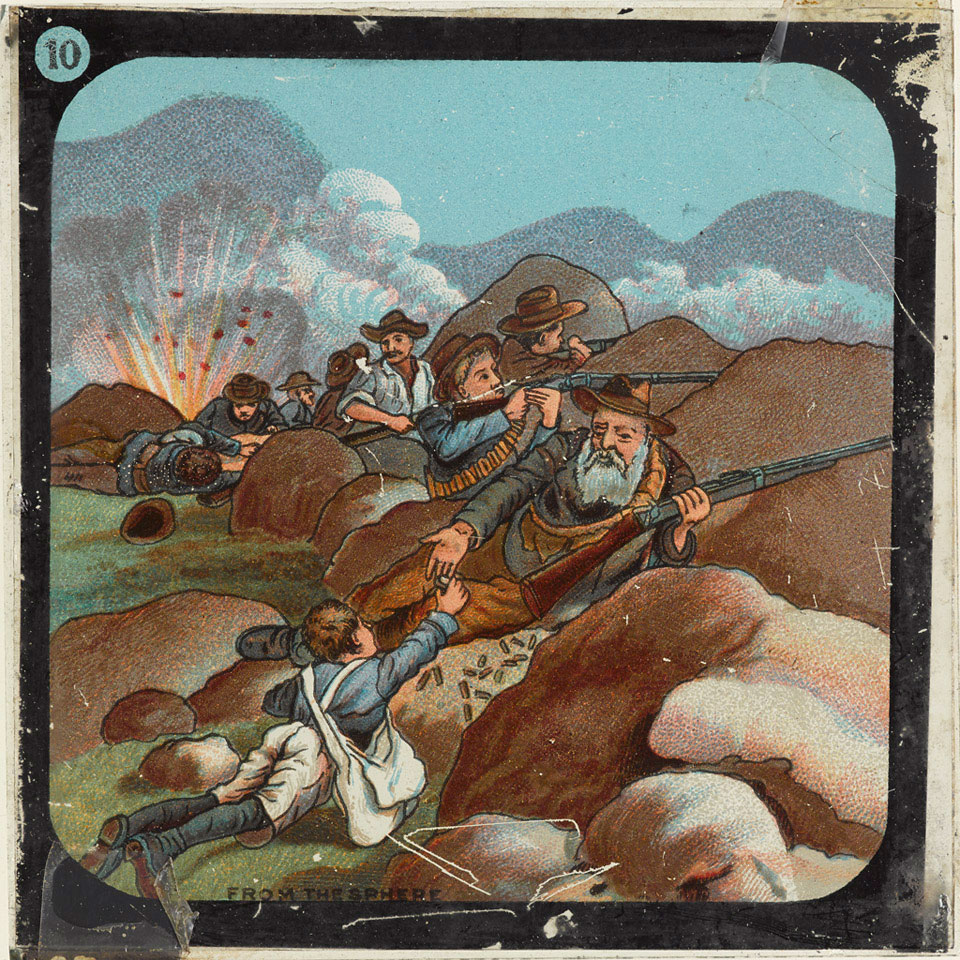
The war's origins lay in the Witwatersrand Gold Rush, which drew thousands of British Uitlanders to the South African Republic. The Boers launched preemptive strikes, besieging Ladysmith, Mafeking, and Kimberley, and won early battles at Stormberg, Magersfontein, Colenso, and Spion Kop.
Reader's Guide
The Second Boer War marked a turning point in British imperial history. Some scholars view it as the beginning of questioning Britain's global dominance.
Did You Know?
- The war is officially called the South African War in South Africa, acknowledging that all South Africans, white and black, were affected.
- International public opinion was sympathetic to the Boers, and volunteers from Germany, the United States, Russia, Australia, and Ireland fought for the Boer cause.
The Great Trek and the Birth of Two Republics
Some groups migrated as far as present-day Mozambique. Yet the peace was fragile; skirmishes and wars against both Boers and African tribes persisted for the rest of the century.
Diamonds, Empire, and the Scramble for Africa
In the 1870s, Britain annexed Griqualand West, the very site of the diamond finds. In the 1880s, the Tswana country became a flashpoint among Germans to the west, Boers to the east, and the British to the south. The underlying drivers were control of trade routes to India via the Cape, the lure of diamond wealth, and the broader race among European powers to claim as much of Africa as possible.
The 1877 Annexation and the Failure of Diplomacy
F. Burgers was in dire straits—financially bankrupt from tax-collection failures and embroiled in a costly war against the Pedi under Sekhukhune in the north-east. Britain saw an opening. Burgers urged the Transvaal government to act decisively, but it failed to grasp the urgency. A delegation including Paul Kruger and E. J. P. Jorrisen travelled to London to plead the Transvaal's case before Carnarvon, but their efforts fell on deaf ears.
The Transvaal War and the Restoration of Sovereignty
The simmering resentment over British rule finally erupted into open conflict. The war was brief but decisive: the Boers emerged victorious, and the South African Republic regained its independence.
Gallery


More in Wars & Conflicts 1-20
Spotted an error? Know more?
This is a living reference — every entry is fact-audited, and reader corrections feed straight into our audit queue. Suggest an edit · See this site's audit record